Monday, May 12, 2014

Do What You DON'T Want To Do (Part Two)

"Take Ownership" and "Love What You Do" are the two most common phrases we often hear in the workspace. Unfortunately, when I took ownership of the business and complain to the GM that he/she shouldn't be running his/her business this way for thousands of reasons - eg it won't work, it won't make a profit, it won't make customers happy, it won't make the employees happy - things became nasty.

I was told by my closest friends and family members:
* It's not your company
* You can't do that, it's disrespectful to the GM. You're telling him he's not good in running the business. You work for him, he pays you to do things, so you follow him 

So how can I work on something that I don't feel the heart to? I don't like the product. I don't like the GM. I don't like the company culture & policies (especially in Asia, some of you know what I mean). I don't like the clients.

Another phrase takes place, "Love what you do." What !?!? How could you do that? Doesn't it have to be "Do what you love"? That's what I have been taught and told !
How could you love something that you didn't 'Love' in the first place? You're forcing yourself to 'love' something that you DON'T ! 

Love comes naturally in your heart, and it flows outward. Not the other way around! At least that's what I have been taught and told by my mentors.

And this is called PASSION. PASSION has been planted by God in your heart since you were little. That's why a lot of kids say "I want to be a pilot. A firemen. A musician. An artist. A singer. "
None of then said "I want to be a Corporate Banker, CEO, CIO, Accountant, Lawyer" which most of these kids will become! Tragically. 

Why? Money. Parents/Family pressure (esp in Asian culture). 
Imagine what the world would become if all of our kids becoming what they have perceived to do when they were little? This is going to be a more beautiful world to live in isn't it?

What if we take money out of the equation? What would you have chosen? 

There's a book called "Do What You Love and The Money Will Follow" by Marsha Sinetar.

Do what you DON'T Want To do (Part One)

"Doing what you want to do" and "Put your heart into your work" don't work for me. They create conflicts and hurt people around me. Lesson learnt.


When we are at work, most people DO NOT want to be there. A lot of people in the top management DO NOT want to do what they have been doing for 20, 30, 40 odd years; a research suggests. 


Following rules and procedures are chores people have to do everyday, what they originally DID NOT want to do, but they HAVE TO. 


Success starts by doing what you DON'T WANT to do. People say working in music industry is fun, being a reporter that travels the world is an amazing job, but they didn't know the hassles of writing reports to your boss, or dealing with difficult clients who book your band or music services are NOT WHAT THEY WANT TO DO, but they HAVE TO. 


The music part is fun and blissful, but in the most part of the job, we do what we don't want to do:

* Playing other people's music, not your own

* Being mistreated by judgmental and unfair clients

* Being paid unfairly by clients or agents

* Facing the politics in the industry

But the music itself, is a great fun!


When corporate workers say "I think I like Accounting, or Finance, or IT". Why then, more than 3/4 of a research poll are unhappy in their job? Yet, they'll stay for long for:

* Stability

* Social Status

* Parents/Family pressure

By staying in this "zone" of doing what they DON'T WANT TO DO, they have placed themselves in what the   society calls "Normal people"; steady income and the ability to raise a family and pay the bills.


$1bn question:

What if they do what they WANT TO DO?

* They don't want to follow procedures and rules

* They don't want to make the shareholders happy, but themselves 

* They want to do what they are passionate about: sports, music, arts. In fact, more than half of above 50s regret that they didn't do what they are passionate about (music, art, sports), only because they have to do what they HAVE TO DO, what they DON'T WANT TO DO.


Is this then the question of "PURPOSE IN LIFE", "What on earth am I here for?" Type of question has popped up in millions of corporate workers' minds. Only because, they do what they DON'T WANT TO DO, they DON'T DO what they are passionate about. And tragically, this is what the society has accepted for more than 4,000 years. 


Imagine those DYING PASSIONS, DYING VISION, and most importantly DYING HEARTS ! We are talking about human hearts, that have taken us to space, invented automobiles, discovered stars in a distant outer space, and many other achievements in this generation. Imagine if every single one of us CHASE OUR DREAMS & PASSIONS !!! Imagine what the world would BECOME !!! IT IS GOING TO BE A DIFFERENT WORLD !! Come on ! Let's keep our PASSION & DREAM alive !

Want to change the world? We can! Start with yourself and neighbours.

Want to create an impact in others? Start today!


There is surely a fine line between "A job" and "A Career". ... (To be continued... Part Two)

Saturday, March 22, 2014

The science behind why better energy management is the key to peak productivity

We live in a culture that seems obsessed with being productive.
While increasing our output and doing more with our time is certainly an admirable goal, according to Tony Schwartz, author of Be Excellent at Anything, that misguided approach is actually liable to hurt your productivity.  
How so?
Without real restoration and rejuvenation throughout the day, people (knowingly) hold themselves back because they are worried about “pacing” their energy to make it through the day.  
This is incredibly damaging to your potential, because it distributes your efforts at 25% across your whole work day instead of reaching 90% output at the moments that correspond with your body’s naturally productive rhythms of alertness. The result is that you aren’t able to do your best work and you aren’t getting the rest you need to rejuvenate yourself either.
I know I’ve fallen into the trap of conventional thinking that to be productive, I just need to work harder. I spend more and more hours at the desk, but when I look back, I’m not sure where the time went.
To Schwartz, not being able to push yourself to 90% output without worry is the biggest impediment holding you back from being truly productive and producing your best work. True productivity is determined by better energy management rather than simply cranking out more hours at your desk.

What do our energy levels actually look like throughout the day?

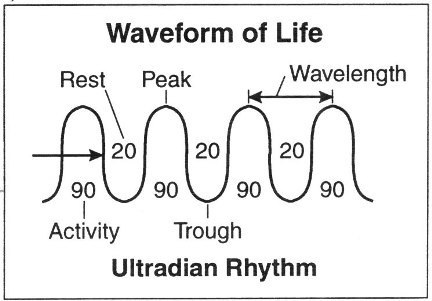
We all have a sense of our energy level, whether we feel productive or not, whether we’re alert and excited or tired and groggy, but most of us try to ignore it and don’t know the science underlying its effect on our work. It turns out that our energy functions according to what psychophysiologist Peretz Lavie called “ultradian rhythms,” or natural cycles that take place during the day.
Lavie conducted a fascinating series of experiments where he put young adults on an ultrashort 15 minute awake-5 minute sleeping schedule in 8-hour sessions, first from  4 pm until midnight, and then after 6-7 hours of sleep, he put them on the 15/5 schedule from about 7 am until early afternoon. He then observed when his test subjects fell asleep and couldn’t fall asleep during this bizarre sleep schedule and came up with some surprising findings.
In the afternoon and evenings, we get sleepy at two times: at 4:30 pm and at 11:30 pm. But in the morning, we get sleepy every 90 minutes. These 90-minute cycles are our ultradian rhythms which define when we’re naturally feeling awake and productive. We perform our best in between those periods of drowsiness.
image
(via DeeperDish)

How do we sync to our natural rhythm?

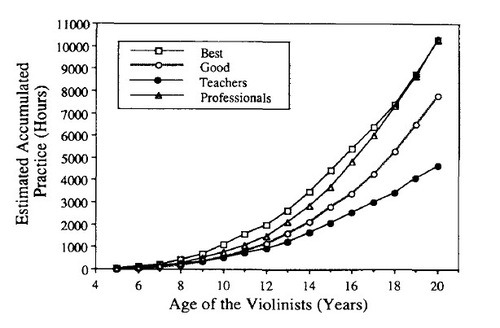
Those who work with instead of against their ultradian rhythm perform better, according to a study on world-class violinists. You might expect the best violinists to practice until their fingers bleed. Not so. Top-tier violinists practice no more than 4 1/2 hours a day, in 90-minute bursts, plus they got more sleep than their peers (notably, 20-30 minute afternoon naps).
It’s not just about concentrating when your energy levels are high. It’s also absolutely vital that you rest when your energy levels hit bottom. One piece of research that Schwartz regularly cites is a Federal Aviation Administration study of pilots on long haul flights that shows the crucial importance of resting when your energy levels are low:
One group of pilots was given an opportunity to take 40-minute naps mid-flight, and ended up getting an average of 26 minutes of actual sleep. Their median reaction time improved by 16% following their naps.
Non-napping pilots, tested at a similar halfway point in the flight, had a 34% deterioration in reaction time. They also experienced 22 micro sleeps of 2-10 seconds during the last 30 minutes of the flight. The pilots who took naps had none.
If you push yourself to continue working during periods of low energy, you risk continued grogginess and low performance. It’s critical that we acknowledge our body’s natural rhythms and align our periods of work and relaxation with them to work in a sustainably productive way.

You improve by pushing your practice, not yourself during low energy. 

In his book Outliers, Malcolm Gladwell popularized the idea that 10,000 hours of “deliberate practice” is what you need to become an expert in your field. Research from psychologist Anders Ericsson on deliberate practice shows that it’s true strain and “wear and tear” that helps people build expertise.  
image
(via K. A. Ericsson, Krampe, R. T., & Tesch-Römer, C. (1993). The role of deliberate practice in the acquisition of expert performance. Psychological Review, 100(3), 363-406)
Although getting into a flow may feel good, sometimes we use the term “flow” to describe times when we’re not pushing ourselves very hard. But it’s the hard practice that allows us to improve. A good metaphor is weightlifting at the gym: while a good flow might involve a 30-minute walk and some light free weights, if you are looking to push yourself into chiseled, six-pack ab territory, you’ve gotta hurt.
Building muscle at that level doesn’t come without pushing into the territory of the uncomfortable, and this is why Schwartz and noted authors like Cal Newport are so adamant about these “hold nothing back” periods of work. During these sessions, it’s vital that we challenge ourselves with increasing difficulty and focus uncompromisingly on how to fix our weaknesses.
When deliberate practice corresponds with periods of intense concentration, we suss out our weaknesses, make progress, and do our best work.

3 Important tricks for managing your energy

  • Break your work sessions into 90-minute blocks: I tested this for myself, and I noticed that the feeling of reckless abandon in being able to give your all for those 90 minute periods was incredibly useful in allowing yourself to pour out creativity without having to think, “What will I have left for the end of the day?”  It’s a surprising bit of mental jiujitsu, but it works: I feel energized and empowered to operate at peak levels because I know that it’s only for 90 minutes.
  • After your 90-minute sessions, take 15 minute breaks: According toSchwartz, breaking up work periods into 90 minute sessions with the knowledge that there will be a 15 minute break at the end is a great process to get started with balancing energy and recovery throughout the day. This way, the 90 minute work period can be approached without having to worry about pacing or burnout: a scheduled break is just on the horizon. It seems strange to allow yourself these sorts of breaks if you are a person who prides themselves with being busy/productive (two very different things, actually), but on the advice of Schwartz and the complementary studies that support it, it’s definitely worth a try.
  • Take Naps: The naps were the hardest sell for me, but after seeing the science behind napping by my buddy Leo Widrich, I was sold on at least giving them a go and was very glad I did: my productivity “dip” around 4pm is now all but gone, thanks to a quick 30-minute nap at 3pm. Schwartz gives this schedule as a sample:
    Nick, by contrast, works intensely for approximately 90 minutes at a stretch, and then takes a 15-minute break before resuming work. At 12:15, he goes out for lunch for 45 minutes, or works out in a nearby gym.
    At 3pm, he closes his eyes at his desk and takes a rest. Sometimes it turns into a 15- or 20-minute nap. Finally, between 4:30 and 5pm, Nick takes a 15-minute walk outside.
Your Turn
What did you think of the research in this post and Schwartz’s approach to finding a work schedule that works with you?
Let me know in the comments, and thanks for reading!
About the AuthorGregory Ciotti is the marketing guy at Help Scout, the invisible help desk software that makes email support a breeze for you and your customers. Get more from Greg on the Help Scoutcustomer loyalty blog.

Friday, March 21, 2014

The Science Behind Why You Procrastinate In The Afternoon (and How To Stop)

It’s 3 p.m. and you find yourself struggling to focus on work. You can’t seem to stop checking Facebook. Instead of being productive, you welcome distractions like text messages and co-workers coming by to chat.
Welcome to the afternoon slump: that time in your workday when your brain refuses to cooperate with you and you can’t stop procrastinating.

Why can’t I focus in the afternoon?

There are many reasons for feeling the mid-afternoon dip. According to a study by Gallup40% of Americans don’t get enough sleep. Getting enough sleep is a cornerstone habit that has many positive effects,mental and physical performance improvements among them. If you’re not getting enough sleep, your brain is not functioning optimally.
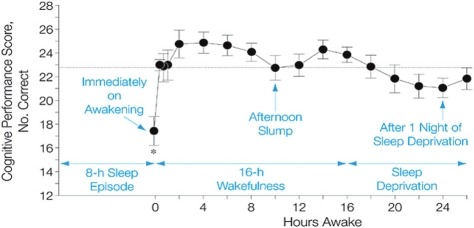
Research also points to our circadian rhythms as a cause of mid-afternoon tiredness. Our mental performance ebbs and flows throughout the day:
image
What you ate at lunch also has an effect. Food coma is a real phenomenon, and when you eat crap, you’ll probably feel like crap.
You could also just be drained after a full morning of tough meetings and debates with your team. Willpower is a finite resource; we all start with a certain amount every day, and it diminishes with every decision or choice we make.
Whatever the reason for your lack of afternoon focus, let’s look at some research-backed lifehacks to help break out of the daily slump and finish your day strong.

1. Eat something, but make sure it has this one thing

Making decisions and concentrating on tasks tire out your brain. It’s an effect called “ego depletion.”
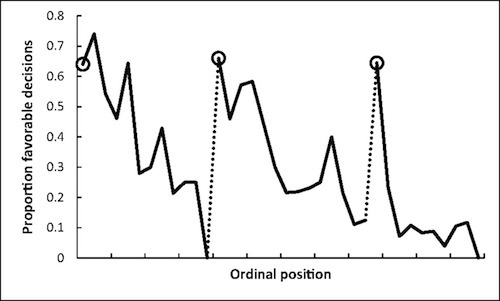
In a study looking at the factors affecting judicial rulings, researchers found that the likelihood of a favorable parole verdict was highest when the judge recently had a food break:
image
We’ll come back to the judges in a second.
In a study about willpower by E.J. Masicampo and Roy Baumeister, participants were asked to watch a silent video of a woman talking while words flashed on screen. One group was asked to focus their attention solely on the woman and try to ignore the words. The second group received no particular instructions.
The researchers measured participants’ blood-glucose levels before and after the task. They found that the group who had to exert effort to ignore the flashing words words had significantly lower glucose than the other group who’d simply watched the video.
So what’s the link between the judges and the silent video?
Glucose — a type of sugar — plays a role in our mental performance and decision-making ability. When your willpower is running low, you tend to make the decision that presents the least resistance. In the judges’ cases, they chose to keep the status quo and deny parole instead of making the much more difficult choice of setting a prisoner free. In your case, it’s choosing between checking Facebook or diving into a spreadsheet.
image
So how do you replenish your willpower?
Eat something and make sure it has the right kind of sugar. Masicampo and Baumeister’s findings showed that sweeteners like Splenda don’t count, and you don’t want to go for a sugary or starchy high either. Instead, as Baumeister suggests in his book, Willpower:
To maintain steady self-control, you’re better off eating foods with a low glycemic index: most vegetables, nuts (like peanuts and cashews), many raw fruits (like apples, blueberries, and pears), cheese, fish, meat, olive oil, and other “good” fats.

2. Take a nap for this long, and no more

It’s the afternoon. You could really use a nap, but you fight the urge. You press on at half your mental capacity instead of taking time to recharge.
We keep seeing more and more literature that napping is not only natural but really good for you. Consider how many of us aren’t getting enough sleep and a siesta starts to make a lot of sense!
image
How long should you nap for?
Before we answer, we have to understand the concept of “sleep inertia,” which is that grogginess you sometimes feel upon waking. That fuzzy feeling isn’t great when you’re in the office. We want to avoid that.
Sleep inertia comes into play after ten minutes of napping. So if you’re looking for a quick pick-me-up, ten minutes seems to be the magical interval for your nap. Anything more than that and you’ll wake up feeling a bit groggy, and you’ll need to spend extra time to grow alert.
For the ultra-efficient, there’s also some evidence that a six-minute nap is enough to improve mental performance.

3. Exercise at lunch, but do this instead of jogging

If you find that you’re always tired, despite eating well and getting enough of sleep, then you may need to get moving during your lunch break. Stress may be the culprit.
One of the many benefits of exercise is that it reduces stress, lowering levels of stress hormones and increasing endorphins, which enhance moods and relieve pain.
With a poll from Everest College showing that 8 out of 10 Americans suffer from work-related stress, and with stress and anxiety among thetop reasons for lack of sleep, it’s clear that people everywhere could use a few more endorphins during office hours.
What kind of exercise should you do?
Fortunately, almost any type of exercise will yield positive results.
image
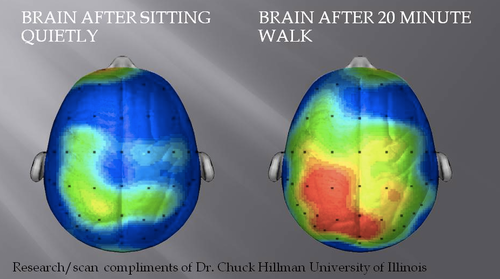
Research led by Charles Hillman shows that even after something as easy as a twenty-minute walk can improve cognitive performance. While these scans illustrate brain activity in nine- to ten-year-olds, studies showcognitive benefits of walking at older ages as well. So get out there and move!
To maximize the release of endorphins, follow advice that high-intensity exercise is best for reducing stress and anxiety. So instead of jogging on the treadmill, do sprints. Not only will you get more endorphins, you’ll be able to get more results in a shorter amount of time.

4. Take a break that benefits your whole team

It’s the afternoon and you’re finding yourself unable to concentrate. What would you normally do in this situation?
If you’re like most people, you’ll try at least one of these things:
- Get a coffee
- Check Facebook
- Chat with a coworker
The logic seems clear: I’ll do something to take my mind off work for a second so I can recharge. Then I’ll return to my desk with more energy.
We’re now learning that such “microbreaks” don’t actually restore our energy. In fact, they take up energy and have the added effect of distracting us.
image
So what should we do on our breaks?
In order to gain the most energy from breaks, do something positive and work-related. Taking a break to compliment a colleague on a job well done, for example, is more effective at boosting your energy than a bathroom break or an afternoon espresso. Plus, compliments are powerful: they can boost your performance.
The next time you need an afternoon jolt, do your team a favor: praise a coworker and you’ll both benefit.

Know Your Mind and Body

It’s impossible to work for 8 consecutive hours. We’re not robots. We need to take breaks and take time to recharge and renew with food, sleep, and exercise.
We’re constantly learning more about willpower, motivation and managing our energy at work. Still, nothing will beat your own firsthand experience. Run your own tests and experiment with ways to recharge. Keep a journal to note when you’re feeling tired and see what works for you!